Table Of Content

Folliculitis can often be cared for at home and doesn’t require a trip to your healthcare provider’s office, but if you do have any concerns it’s best to call your provider. Folliculitis is typically caused by a bacterial or fungal infection of the hair follicles. In some cases, it can be caused by irritation from shaving, tight clothing, or other factors. By week 22 of pregnancy, babies already have all of their hair follicles, or openings in the skin where hair grows. This totals about five million hair follicles, with about one million on the head and 100,000 on the scalp.
What are common types of hair loss?
Pepper used a new cooling cap technology during her chemotherapy treatment. Hair loss, or alopecia, affects more than 80 percent of men and 50 percent of women, and the risk increases with age. The tunnels and thickened scar tissue can cause chronic pain and inhibit movement of the arms or legs. Your skin may feel irritated and sore, especially when pimples and cysts form in areas that rub together and cause friction. You can use one of these emollients as a soap substitute until the folliculitis has cleared.
What are common causes of hair loss?
Doctors can treat severe folliculitis with a prescription-strength antifungal or antibiotic ointment. They can also prescribe a medicated shampoo that relieves itching, and helps kill infectious microbes. If a follicle has been damaged, it’s not possible to restimulate it. Francie Pepper, 83, was diagnosed with cancer 3 years ago.
Cinnamic acid promotes elongation of hair peg-like sprouting in hair follicle organoids via oxytocin receptor activation ... - Nature.com
Cinnamic acid promotes elongation of hair peg-like sprouting in hair follicle organoids via oxytocin receptor activation ....
Posted: Tue, 27 Feb 2024 08:00:00 GMT [source]
Fungal Infections
Their effectiveness largely depends upon what type of alopecia you have and how quickly you start treatment. Here, dermatologists share what you need to know about alopecia, including possible causes, treatment options and what you can do to prevent more hair loss. In this article, we explain why blocked hair follicles occur and how you can prevent and treat them. Most cases of folliculitis are not contagious but if you have recurrent or chronic folliculitis and have been identified as carrying the S. Aureus germ (bacterium), this infection can occasionally be transferred to other people.

Publication types
Folliculitis that’s due to an infection sometimes clears up, then returns. Folliculitis that’s caused by staph can start to grow inside your body. While this is uncommon, it can be deadly if not treated right away. Most of the time, folliculitis clears up without any issues. Or you could notice that the skin in the affected area is lighter or darker than your usual skin tone. Depending on the cause of your folliculitis, you could also lose hair that doesn’t grow back.
Causes of folliculitis
Different follicles go through different phases of the cycle at the same time. Some follicles are in the growth phase while others might be in the resting phase. Some of your hairs might be growing, while others are falling out. The average human has about 100,000 hair follicles on the scalp alone. We’ll explore what hair follicles are and how they grow hair. During periods of stress, more hair enters the telogen phase and begins to fall out.
What are the best treatments for alopecia?
Hair follicles form the basis of the two primary methods of hair transplantation in hair restoration, Follicular Unit Transplantation (FUT) and follicular unit extraction (FUE). These follicles are extracted from donor areas of the scalp, or other parts of the body, which are typically resistant to the miniaturization effects of the hormone DHT. It is this miniaturization of the hair shaft that is the primary predictive indicator of androgenetic alopecia,[22] commonly referred to as male pattern baldness or male hair loss. Folliculitis is a common skin condition that occurs when hair follicles become inflamed and infected.
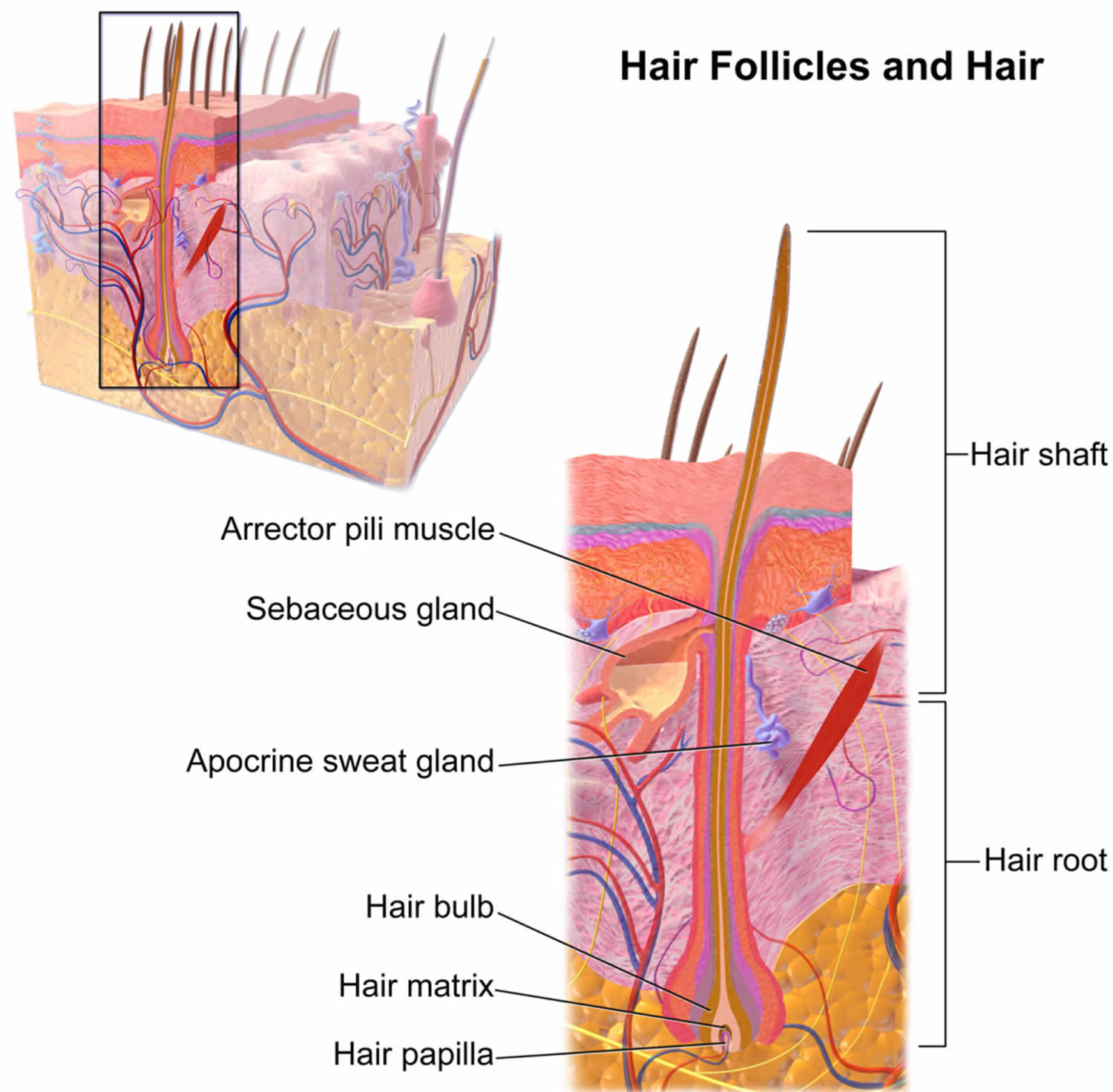
In some more severe cases, your provider may refer you to a dermatologist for additional tests to make sure your folliculitis isn’t another medical condition. This is a test where a small sample of your skin is removed and then taken to a lab where it’s studied. You can dilute the oil with a carrier oil, like coconut oil or jojoba oil, and apply it to the affected area several times a day, as directed. The sebaceous gland produces sebum, or oil, which is the body’s natural conditioner. More sebum is produced during puberty, which is why acne is common during the teen years.
When hair follicles become infected or inflamed they swell causing a red bump on the skin. Sometimes the affected follicles fill with pus, covering the affected skin with small, rounded, yellow-red spots (pustules). Affected skin may develop a crust, which can be yellow or golden coloured due to infection.
3D-printed skin closes wounds and contains hair follicle precursors - Penn State University
3D-printed skin closes wounds and contains hair follicle precursors.
Posted: Fri, 01 Mar 2024 08:00:00 GMT [source]
In certain, severe or persistent cases, an appointment with a dermatologist is recommended. If a person has an underlying health condition that weakens their immune system, they may be at a higher risk of scalp folliculitis. They may wish to speak to a doctor, who can help manage their condition and prevent scalp folliculitis.
Carbuncles are clusters of boils that are usually found on the back of the neck or thigh. Staphylococcus aureus is the most common bacteria to cause these infections. Outside of minoxidil, finasteride is a prescription pill for men with male pattern baldness. Many who take this medication will see new hair growth or the slowing of their existing hair loss.
It can be challenging to treat blocked hair follicles, but early treatment can help to significantly reduce the severity of this condition. Blocked hair follicles range in severity from mild to severe. They start out looking like small and irritated red pimples. Over time, they may look like pus-filled lumps, cysts, or boils.
Its function is to produce hair and enclose the hair shaft. A hair follicle consists of two main layers, an inner (epithelial) root sheath and an outer (fibrous) root sheath. At the base of the hair follicle is the hair bulb, which houses the dermal papillae and hair matrix cells. It is formed from dermal connective tissue, supplies blood to the epithelial sheath and holds undifferentiated hair stem cells.
Unlike ACC, there is no skin defect at birth, only hypotrichosis, which can be treated with routine follicular unit grafting techniques. Aplasia Cutis CongenitaAplasia Cutis Congenita (ACC), is the medical description for non-growth or absence (i.e. aplasia), of skin (i.e. cutis), at birth (i.e. congenita). Finally, keep in mind that the same healthy habits recommended for maintaining your physical health will also help your hair. Try to find ways to manage stress, and strive for a well-balanced diet that includes plenty of fruits and vegetables. If you have alopecia, you can help hold onto your tresses by avoiding behaviors that are known to contribute to temporary and permanent hair loss, Mirmirani says. Dozens of over-the-counter supplements and products purport to reverse hair loss, making it tough for patients to know which ones work and which don’t.


No comments:
Post a Comment